
.png)
Hiring Independent Contractors in the EU: Rules, Risks and Compliance
Hiring Independent Contractors in the EU: Rules, Risks and Compliance
Hiring independent contractors in the EU often looks straightforward at first. I see this assumption all the time. In reality, it is one of the quickest ways to create complex legal risk if the model is not set up properly from the start.
The biggest mistake I see companies make is trying to apply a contractor model from one country across the entire EU. That approach does not hold up. Each country applies its own legal tests and its own interpretation of what independence actually looks like in practice. The result is that the same working arrangement can be acceptable in one jurisdiction and a clear case of misclassification in another.
What has changed in recent years is enforcement.
Regulators are looking beyond contracts and focusing on how the relationship actually operates day to day, particularly in remote and cross-border setups. Developments at EU level, including the Platform Work Directive, are reinforcing that direction of travel.
This is where the risk becomes real. If a contractor is reclassified, the liability sits with the business. That can include back taxes, unpaid social contributions, employment rights claims, and financial penalties, often applied retrospectively. In a multi-country setup, issues also tend to escalate rather than stay contained.
Key Takeaways:
- There is no single EU-wide definition of an independent contractor, as each country applies its own legal tests and classification criteria.
- Contractor status in the EU is determined by working reality, not contract terms, with regulators focusing on control, integration, and economic dependence.
- A contractor model that works in one EU country may fail in another, even if the working arrangement remains exactly the same.
- Misclassification can result in significant financial liability, including back taxes, social contributions, employment rights claims, and penalties.
- Cross-border hiring increases compliance risk, as businesses must meet different legal standards across multiple jurisdictions simultaneously.
- Long-term or exclusive contractor relationships increase scrutiny, particularly where economic dependence on a single company can be demonstrated.
- The Platform Work Directive signals stricter enforcement around control and classification, particularly for roles that resemble employment in practice.
- Relying on contracts or labels alone does not protect against reclassification, as regulators consistently apply a substance over form approach.
What Counts as an Independent Contractor in the EU
Understanding what counts as an independent contractor in the EU starts with one critical point. The definition does not come from your contract. It comes from how the relationship actually works in practice.
At a high level, many frameworks in different EU countries treat an independent contractor as a separate business providing services to a company without being under its control or integrated into its structure. That sounds simple, but in practice, regulators apply a much stricter lens.
The role of “subordination” in EU classification
Across EU jurisdictions, a key legal concept is subordination. This is a test regulators use to decide whether someone is truly independent or effectively an employee.
In practical terms, subordination exists where the company:
- Controls how the work is carried out
- Sets working hours or availability expectations
- Directs the individual’s day-to-day activities
- Integrates the person into internal teams or processes
If these elements are present, the relationship starts to look like employment, regardless of how it is labelled.
Economic reality matters more than contracts
EU authorities consistently apply a substance over form approach. That means they assess the economic reality of the relationship, not the wording of the agreement.
This is where many businesses get exposed:
- A signed contractor agreement does not determine status
- Invoicing does not prove independence
- Having a registered company does not remove risk
If the individual works like an employee in practice, the classification will not hold.
Contractor vs employee in the EU context
The distinction ultimately comes down to independence versus integration.
A genuine contractor will typically:
- Operate as an external business
- Control how services are delivered
- Work with multiple clients
- Remain outside the company’s internal structure
An employee, by contrast, will:
- Work under the company’s direction
- Follow internal processes and schedules
- Be economically dependent on one employer
- Form part of the organization
Understanding this difference is what allows you to structure contractor relationships that actually stand up under EU scrutiny.
Key Classification Tests Across EU Countries
So how do you actually determine whether a contractor is valid across the EU?
The short answer is this. There is no single EU-wide test. Each country applies its own legal framework, but they all come back to the same core question: is this person genuinely independent, or are they working like part of your business?
To answer that, regulators consistently focus on three core factors.
How EU countries assess contractor status
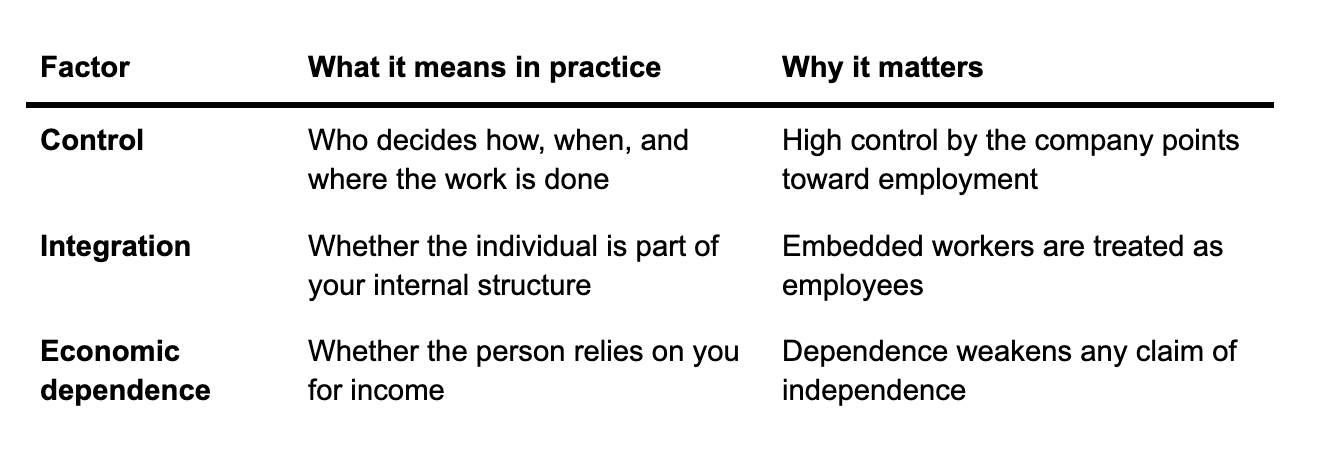
These are not abstract legal ideas. They are practical tests applied to how the relationship actually works day to day. As outlined in the broader contractor framework, regulators consistently prioritise substance over form when making this assessment.
How contractor classification plays out across EU countries
While the underlying principles are consistent across the EU, the level of scrutiny, legal interpretation, and enforcement risk varies by country. This is where many contractor models break down from a practical standpoint.
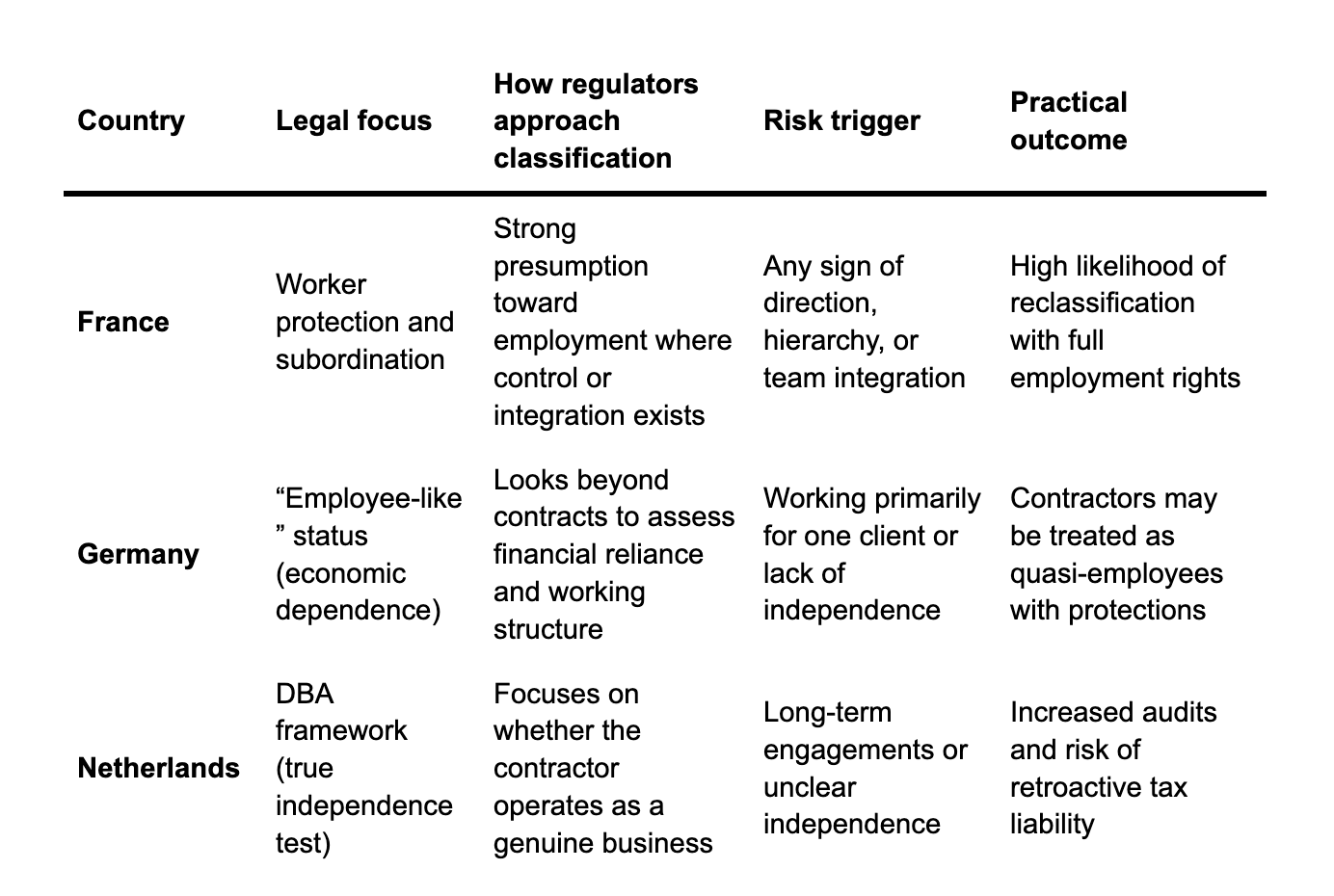
The important point is straightforward. The same contractor setup can be compliant in one country and fail in another.
That is why applying a single, standardised contractor model across the EU creates risk by default.
What this means
This is why a single contractor model does not work across the EU.
If you apply one approach across multiple jurisdictions without adjusting for local rules, you are relying on consistency that does not exist. The safer approach is to assess each relationship based on how it operates locally, not how it is structured centrally.
Once you understand that, the path becomes clearer. You are not trying to “fit” contractors into a model. You are making sure the reality of each relationship supports the classification in the country where the work is performed.
Why Misclassification Risk Is Higher in the EU
Misclassification risk in the EU is higher than most companies expect, and it comes down to one simple reality. The legal framework is designed to protect workers first, not to accommodate flexible hiring models.
That shift in focus changes how contractor relationships are assessed. It is not enough for a setup to look commercially reasonable. It has to meet stricter legal thresholds that often lean toward employment by default.
Strong worker protection drives classification
EU labour systems are built around protecting individuals who are economically dependent on a business. That means regulators are far more willing to question contractor arrangements, particularly where there is any sign of control or integration.
In practical terms, if there is doubt, authorities are more likely to resolve it in favour of employment status rather than independence.
Presumption of employment in practice
In several EU jurisdictions, there is either a formal or informal presumption of employment. This means the burden is not on the regulator to prove someone is an employee. It is on the company to prove they are not.
That is a fundamental shift, and if you cannot clearly demonstrate independence through how the relationship operates, the classification becomes difficult to defend.
The impact of the Platform Work Directive
Recent developments, particularly the Platform Work Directive, reinforce this direction of travel. The framework introduces clearer criteria for determining control and, in some cases, creates a presumption of employment where those criteria are met.
While it is aimed at platform-based work, the underlying logic applies more broadly. Control, supervision, and integration are being treated as decisive indicators across EU hiring models.
Cross-border hiring increases complexity
The moment you hire across multiple EU countries, the risk increases.
Each jurisdiction applies its own interpretation of independence, its own enforcement standards, and its own thresholds for what constitutes employment. A contractor arrangement that works in one country can fail in another without any change in how the work is performed.
This makes standardisation difficult and increases the likelihood of inconsistent compliance across your workforce.
Increased audits and enforcement focus
Regulators are not passive in this area. Misclassification is seen as lost tax revenue and reduced worker protection, which makes it a priority for enforcement.
Audits are becoming more frequent, and they are increasingly data-driven. In many cases, it only takes one challenge or inconsistency to trigger a broader review of your contractor population.
What this means in practice
The key point is this. Misclassification risk in the EU is not higher because the rules are unclear. It is higher because the rules are applied more strictly, and the consequences are enforced more consistently.
If you approach EU hiring with a “contract-first” mindset, you will run into problems. If you focus on how the relationship actually operates, and align that with local expectations, you put yourself in a far stronger position.
Common EU Contractor Mistakes Employers Make
Most misclassification issues in the EU do not come from deliberate risk-taking. They come from reasonable assumptions applied in the wrong context. What works in one market is often rolled out across others without adjustment, and that is where problems begin.
Applying a single global contractor model
One of the most common mistakes is assuming you can standardise contractor engagements across multiple countries. In reality, there is no single EU-wide approach that works everywhere.
Each jurisdiction applies its own legal tests and thresholds. A model that holds up in one country can fail in another without any change in how the work is performed. Treating the EU as a single compliance environment is where many businesses expose themselves.
Over-reliance on contracts and labels
Another consistent issue is placing too much weight on documentation.
A well-drafted contractor agreement, clear terms, and invoicing structure may give the impression of compliance, but they do not determine legal status. Authorities look beyond the paperwork and assess how the relationship operates in practice.
If the reality does not match the contract, the contract carries very little weight.
Treating contractors like employees
This is where misclassification risk becomes most visible.
If contractors are working fixed hours, following internal processes, using company tools, and reporting into management structures, the relationship begins to mirror employment. These are exactly the indicators regulators focus on when assessing status.
The shift often happens gradually. What starts as a project-based engagement becomes embedded in day-to-day operations. That change in behaviour is what creates exposure.
Long-term exclusive engagements
Exclusivity and duration are another common trigger.
Where a contractor works primarily or exclusively for one company over an extended period, it raises questions around economic dependence. The longer the relationship continues, the more it starts to resemble a permanent role rather than an independent service.
This does not automatically create employment status, but it significantly weakens the argument for independence.
Ignoring local employment thresholds
Finally, many businesses underestimate how important local rules are.
Each EU country has its own thresholds for what constitutes employment, including how control, integration, and dependence are interpreted. Ignoring those differences, or assuming they will align with your home market, creates avoidable risk.
Tax, Legal, and Operational Consequences
If a contractor is misclassified in the EU, the consequences are not limited to correcting paperwork. The issue is treated as a failure to meet tax, employment, and regulatory obligations, and the financial and legal exposure sits with the business.
Back taxes and social contributions
The first and most immediate impact is tax liability.
If a contractor is reclassified as an employee, authorities can require the company to pay backdated income tax, employer social contributions, and related charges. These liabilities are often applied retrospectively, covering several years, with interest added on top.
In many cases, the total cost is significantly higher than what would have been paid if the individual had been classified correctly from the outset.
Retroactive employment rights claims
Reclassification does not stop at tax. It also opens the door to employment rights. The individual may be entitled to backdated benefits such as paid holiday, sick leave, pension contributions, and other statutory protections.
In some cases, this can lead to formal claims or legal proceedings, particularly if the individual has been treated as a contractor while working like an employee. This creates both financial exposure and operational disruption.
Fines and penalties
In addition to recovering unpaid taxes and contributions, regulators may impose financial penalties.
These penalties vary by country but are typically linked to the scale and duration of the misclassification. Where authorities view the issue as systemic rather than isolated, the financial impact can increase significantly.
The combination of back payments and penalties is where costs escalate quickly.
Permanent establishment risk
In cross-border scenarios, there is an additional layer of risk. If a contractor is operating in a way that resembles an employee in another country, it can create what is known as permanent establishment risk.
This means the company may be considered to have a taxable presence in that jurisdiction.
The consequence is exposure to corporate tax obligations in a country where the business did not intend to operate formally.
Reputational damage in EU markets
Beyond the financial and legal consequences, there is a reputational dimension.
Misclassification cases can become public, particularly in jurisdictions with strong worker protections. This can affect how your business is viewed by regulators, partners, and talent in the market. For companies expanding across the EU, that reputational impact can make future hiring and operations more difficult.
The key point is this: Misclassification is not a contained issue.
It does not sit within one function or one relationship. It cuts across tax, legal, and operational areas of the business, and the effects tend to compound once identified.
That is why addressing classification early, and structuring contractor relationships correctly from the outset, is far less costly than dealing with the consequences later.
Best Practices for Hiring Contractors in the EU
Hiring contractors in the EU can work well, but only if you approach it with the right structure from the start. The difference between a compliant setup and a high-risk one is rarely the contract. It is how deliberately you design and manage the relationship.
Conduct country-specific classification assessments
Start with the basics. Every contractor engagement should be assessed under the local rules of the country where the work is performed.
There is no reliable “one-size-fits-all” model across the EU. Each jurisdiction applies its own tests and thresholds, so you need to understand how independence is defined locally before you engage the contractor. Skipping this step is where most risk is introduced.
Structure engagements around outcomes, not roles
A contractor should be engaged to deliver a specific result, not to fill a position inside your business.
If the role looks like something you would normally hire an employee to do on an ongoing basis, that is already a warning sign. Structuring the engagement around defined deliverables helps reinforce the distinction between external provider and internal staff.
Avoid control and integration
Control and integration are the two strongest indicators regulators rely on. In practice, that means avoiding detailed direction over how work is carried out, limiting involvement in internal processes, and keeping contractors outside your organizational structure.
The more the individual looks like part of your team, the harder the classification becomes to defend.
Use local legal or advisory support
Given how much the rules vary, relying on local expertise is not optional.
Whether through legal advisors or employer of record (EOR) providers, having jurisdiction-specific input ensures that your contractor model aligns with local expectations. It also helps identify risks early, before they become more difficult to manage.
Document independence clearly
Documentation still matters, but it needs to reflect reality. Contracts should clearly define scope, independence, and the absence of control, but they should also be supported by how the relationship actually operates.
Supporting documentation, such as statements of work and communication practices, can help reinforce your position if it is ever reviewed.
Regularly audit contractor relationships
Finally, treat classification as an ongoing process.
Contractor relationships often evolve over time. What starts as a clean, project-based engagement can gradually shift into something that looks more like employment. Regular reviews help identify that drift early and allow you to correct it before it becomes a compliance issue.
What this means in practice
The businesses that manage this well are not relying on assumptions. They are actively shaping how contractor relationships are structured and maintained.
If you approach EU hiring with that mindset, you reduce risk significantly and create a model that can scale without constant exposure to reclassification issues.
How to Manage Cross-Border Contractor Compliance
Managing contractors across multiple EU countries is where things become operationally complex. The challenge is not just understanding the rules. It is applying them consistently while respecting the fact that each country enforces them differently.
Centralized vs local compliance strategy
Most companies start with a centralized approach, creating one contractor model and applying it across all markets. That works from an operational standpoint, but it rarely holds up legally.
A more effective approach is a hybrid model. You keep a consistent internal framework for how contractors are engaged, but you adapt it to meet local legal requirements in each jurisdiction. This allows you to maintain control while still respecting country-specific rules.
When to localise contracts
Localising contracts becomes necessary when the legal differences between jurisdictions start to affect how the relationship is interpreted.
If you are hiring in multiple EU countries, relying on a single contract template increases the risk that it will not align with local expectations. Adjusting terms such as scope, control, substitution, and independence ensures that the agreement reflects how the relationship needs to be viewed under local law.
Managing multi-country contractor teams
As your contractor workforce grows across borders, consistency in how relationships are managed becomes critical.
This means ensuring that internal teams understand the boundaries of contractor engagement. Managers should know what they can and cannot do in terms of direction, integration, and oversight. Without that clarity, even well-structured agreements can break down in practice.
It also requires visibility. You need to understand where your contractors are based, how they are working, and whether those arrangements still align with local compliance requirements.
When to switch to employment or EOR models
There are situations where maintaining a contractor relationship is no longer the right approach.
If the role becomes long-term, highly integrated, or requires a level of control that cannot be avoided, it may be more appropriate to move to employment or use an employer of record (EOR) model. This reduces the risk of misclassification and provides a clearer legal framework for managing the individual.
Building a Compliant Contractor Model Across the EU
Hiring independent contractors across the EU is about making sure the reality of the relationship aligns with how each country defines independence. The same setup can succeed in one jurisdiction and fail in another, which is why a standardised approach creates risk by default. Businesses that manage this well focus on how work is structured in practice, not how it is labelled on paper.
I work directly with companies hiring across the EU to assess contractor setups, identify exposure, and build compliant, scalable models that hold up under scrutiny. If you’re reviewing your current model or planning to scale into new markets, this is the point to get clarity before issues surface. Book a consultation to review your contractor setup and make sure it is built to scale across the EU.




.jpg)