
.png)
Freelancer vs Contractor: Legal Differences Explained
Freelancer vs Contractor: Legal Differences Explained
Most employers use “contractor” and “freelancer” as if they mean the same thing. In practice, that assumption is where confusion starts.
“Freelancer” is not, in most jurisdictions, a standalone worker-status category that determines legal classification. It is a commercial label. What actually matters is how the law views the working relationship, and that is determined by the underlying reality of how the work is performed, not the terminology used internally. This is the same principle explored in our independent contractor guide , where classification depends on control, integration, and economic dependence rather than labels.
This matters because unclear language leads to unclear decisions. If your business treats “freelancers” as automatically independent, without assessing how those relationships actually operate, you increase the risk of inconsistent classification across your workforce.
That inconsistency is where exposure builds. Misclassification does not usually come from a single obvious mistake. It comes from small assumptions repeated across multiple engagements, often based on terminology rather than legal substance.
In this article, I will clarify the difference between freelancers and independent contractors, explain how the law approaches both, and show how to structure these relationships in a way that reduces risk while still allowing flexibility.
Key Takeaways:
- “Freelancer” is not a standalone legal classification in most jurisdictions, and does not determine worker status on its own.
- Worker classification is based on how the relationship operates in practice, not the terminology used internally.
- Control, integration, and economic dependence are key indicators of employment risk, regardless of whether someone is labelled a freelancer or contractor.
- Using “freelancer” and “contractor” interchangeably can lead to inconsistent classification decisions, particularly across teams or regions.
- Misclassification risk often builds gradually through day-to-day management, not from a single obvious mistake.
- Contracts, invoices, and formal agreements do not override the reality of the working relationship, and offer limited protection on their own.
- A consistent internal classification framework reduces risk and improves defensibility, especially in organisations using multiple engagement models.
- Jurisdiction-specific rules must be considered in every engagement, as legal tests and thresholds vary by country.
Freelancer vs Contractor (Terminology vs Legal Reality)
The difference between a freelancer and an independent contractor is often misunderstood, so let’s answer it directly. A freelancer is a commercial label, while an independent contractor is a legal classification. That distinction matters more than most businesses realise.
Freelancer vs contractor meaning in practice
In everyday use, “freelancer” is a broad, informal term. It is used to describe someone who works independently, often on short-term or project-based engagements. It is useful commercially, but it has no fixed legal definition.
An independent contractor, on the other hand, is a classification that sits within legal and tax frameworks. It is not based on what you call the individual, but on how the relationship operates in practice. Authorities apply status tests to determine whether that person is genuinely independent or effectively working as an employee.
Why the law ignores labels
This is where many businesses go wrong. They assume that calling someone a freelancer supports a contractor classification. It does not.
Regulators apply a substance-over-form approach. They look past titles and focus on the reality of the working relationship. If the individual is controlled, integrated, or economically dependent on the business, the label becomes irrelevant.
This is the same principle outlined in the broader classification framework , where status is determined by control, integration, and economic reality rather than terminology.
What this means for classification decisions
If you rely on internal language instead of legal criteria, you introduce inconsistency. One team may treat “freelancers” as external providers, while another manages them like employees. That inconsistency is exactly what creates misclassification risk.
The safer approach is to separate language from legal assessment. Use whatever terminology works commercially, but always test the relationship against the legal standards that apply in the relevant jurisdiction.
How These Roles Actually Operate in Practice
So how do freelancers and contractors actually differ in real working environments?
In most cases, they don’t. The majority of freelancers are treated as independent contractors in practice. The real issue is not the label, but whether the way the person works reflects genuine independence or starts to resemble employment.
To understand where this works and where it breaks down, you need to look at how these roles typically operate.
How freelancer and contractor roles overlap
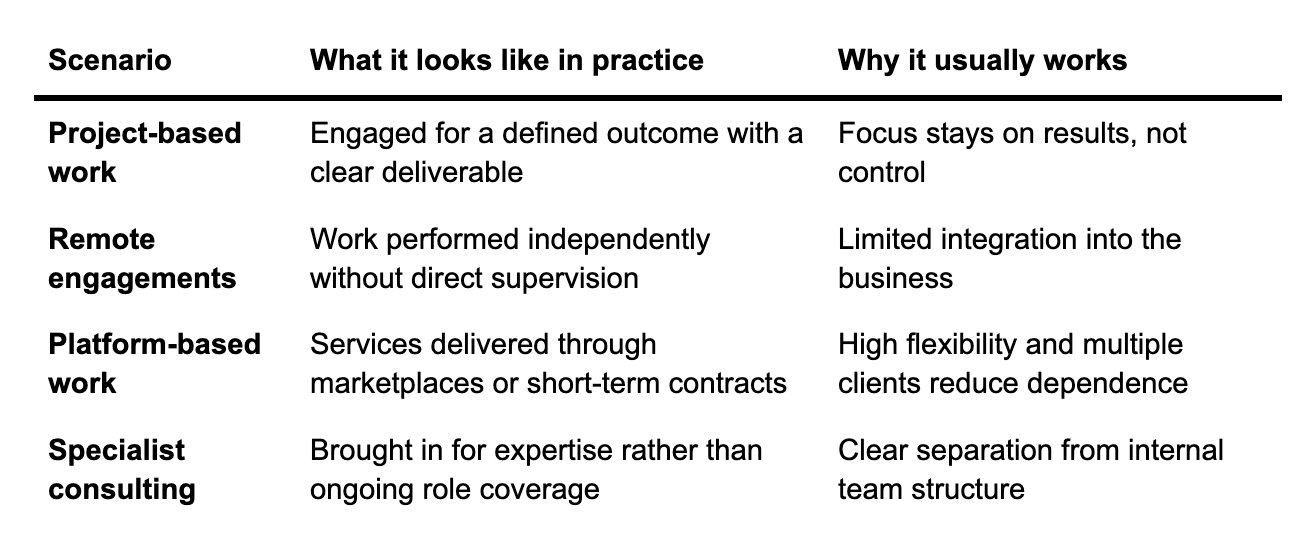
In these situations, freelancers and contractors are effectively operating in the same way. The relationship is outcome-driven, and independence is visible in how the work is carried out.
Where risk starts to emerge
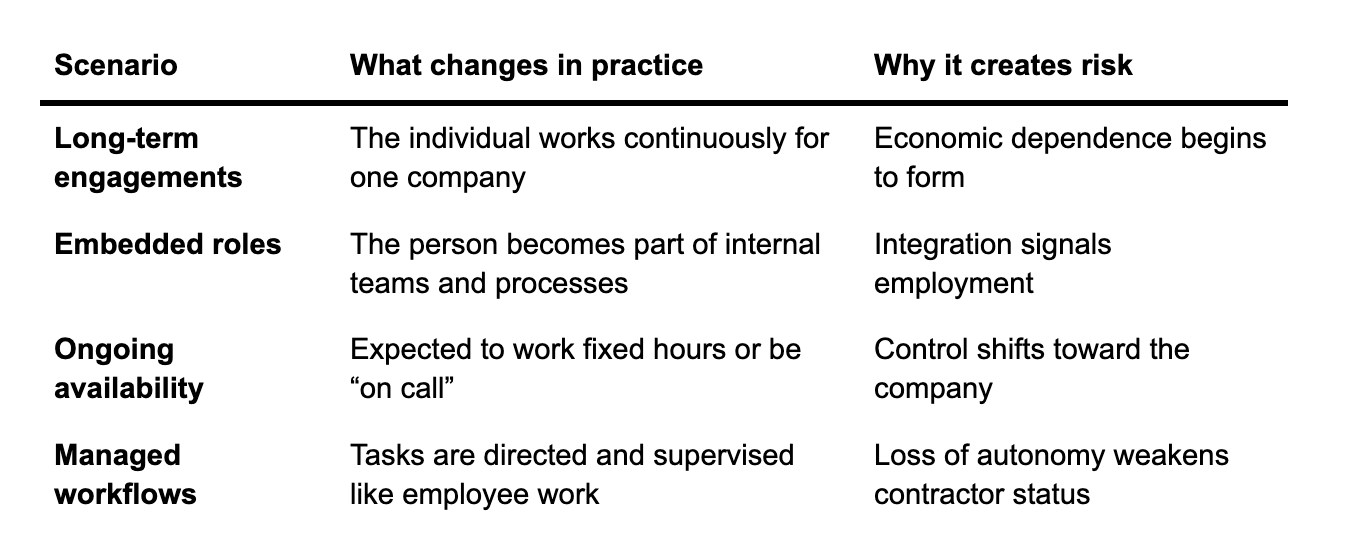
This is where the classification starts to drift. The label stays the same, but the reality changes.
The difference between a compliant contractor and a misclassified worker is not how the relationship starts. It is how it evolves.
This is why the core principles matter. Control, integration, and economic dependence are not abstract legal tests. They are practical indicators of how the relationship is functioning day to day.
If a freelancer operates independently, the classification usually holds. If they become part of your team in everything but name, the risk builds quickly.
Where Employers Create Risk
The biggest risk in freelancer vs contractor classification does not come from the law being unclear. It comes from how employers apply it in practice.
Many businesses assume that calling someone a “freelancer” somehow reduces risk. It does not. In fact, most misclassification issues start with that exact assumption.
Treating “freelancer” as a safer category
A common mistake is treating freelancers as a separate, lower-risk group.
From a legal perspective, that distinction does not exist. Whether someone is called a freelancer or a contractor, the same classification tests apply. If the individual is controlled, integrated, or economically dependent, the label offers no protection.
Inconsistent engagement models across teams
Risk also builds when different parts of the business engage contractors in different ways. One team may use freelancers for clearly defined, outcome-based work, while another treats them as ongoing team members. That inconsistency makes it difficult to defend classification decisions if challenged.
Lack of internal classification policy
Without a clear internal framework, decisions are often made on a case-by-case basis. This leads to variation in how contractors are managed, how roles are structured, and how independence is maintained.
Over time, that lack of consistency creates exposure across the workforce.
Over-reliance on contracts and invoices
Another recurring issue is assuming that documentation is enough. Contracts, invoices, and formal agreements are important, but they do not determine status. Authorities will always look at how the relationship operates in practice. If the day-to-day reality does not match the contract, the contract carries little weight.
Ignoring jurisdiction-specific rules
Finally, many businesses underestimate how much local law matters.
Each jurisdiction applies its own interpretation of control, integration, and economic dependence. Ignoring those differences, or applying a single global approach, increases the likelihood of misclassification.
Policy Recommendations for Consistent Freelancer or Contractor Classification
So how do you actually reduce misclassification risk when your business uses freelancers and contractors across teams?
The answer is to build a consistent internal framework that ensures every engagement is assessed and managed against the same legal standards. When classification is structured properly, the terminology becomes far less important because the underlying reality supports the position.
How to build a consistent contractor classification framework
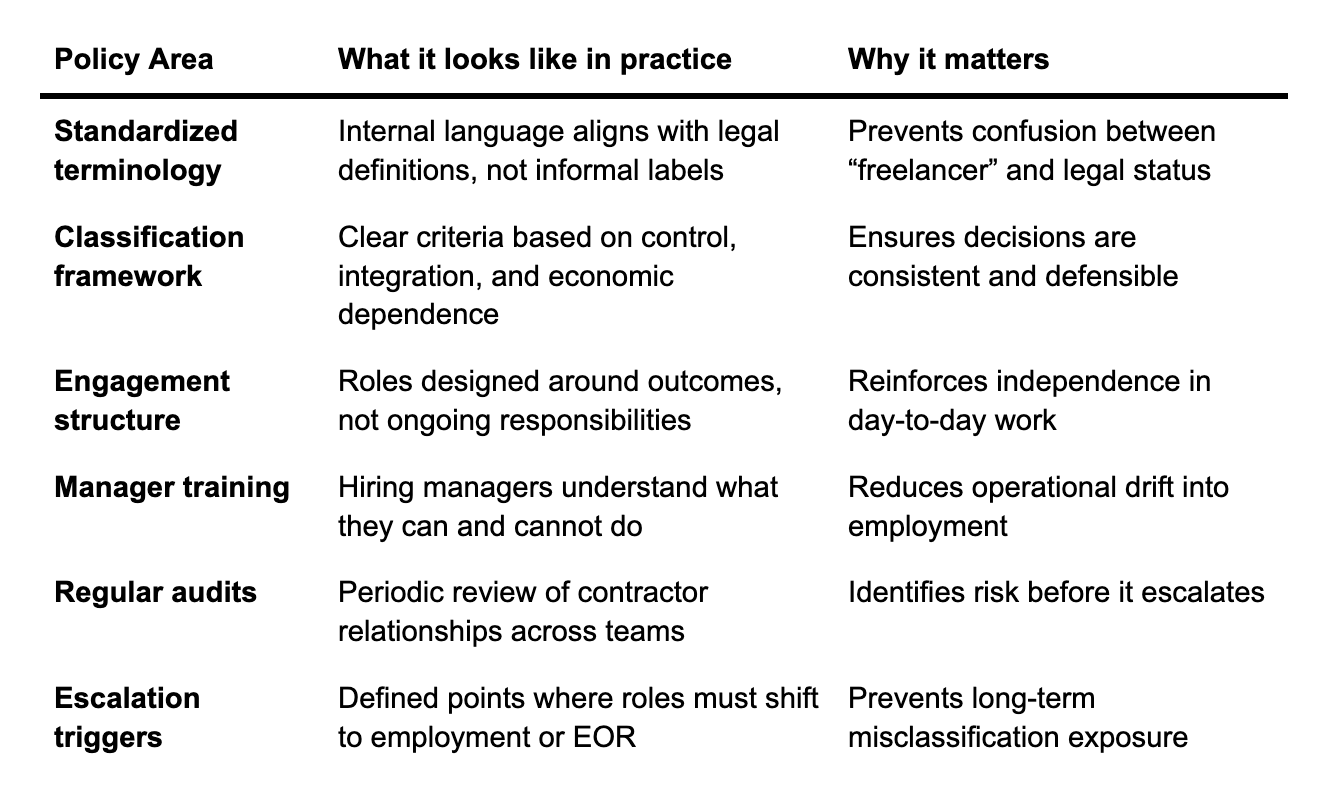
What this means
Most misclassification issues do not come from a single decision. They come from a lack of structure over time.
A contractor starts in a compliant setup, but as the relationship evolves, the boundaries blur. Without clear internal policies, that shift goes unnoticed until it becomes a problem.
A consistent framework solves this. It creates alignment across teams, ensures decisions are based on legal reality rather than assumptions, and makes it easier to scale hiring without increasing risk.
In simple terms, you are not relying on labels to protect you. You are building a system where the way work is structured supports the classification from the outset.
Structuring Freelancer and Contractor Relationships Correctly
Using terms like “freelancer” and “contractor” interchangeably may feel harmless, but from a legal perspective, it creates risk. What matters is not the label, but whether the reality of the relationship reflects genuine independence. Businesses that get this right focus on how work is structured, managed, and assessed across teams, rather than relying on informal terminology.
I work with companies to bring consistency to how contractor relationships are defined and managed, ensuring classification decisions are grounded in legal reality rather than internal language.
If you’re using freelancers and contractors across your organisation, this is the point to step back and review how those relationships operate in practice. Book a consultation to review your contractor setup and ensure it is structured to support compliant, scalable hiring.




.jpg)