
.png)
What is an Independent Contractor? What Employers Should Know
Independent Contractor Definition: An Employer Compliance Guide
Many firms are unknowingly sitting on a ticking compliance timebomb: the misclassification of independent contractors. As global hiring becomes the standard and remote work evolves, the line between a genuine "freelancer" and a "de facto employee" has blurred. Meanwhile, tax authorities and regulators are sharpening their focus, viewing misclassification as a primary source of lost revenue and weakened worker rights.
Ignoring this isn't just a minor administrative slip, it is a significant strategic risk. When the status of a workforce is called into question, the fallout often includes crippling fines, back-dated social security contributions, and retrospective employment claims that can devastate a balance sheet. To protect your organisation, you need to look past the "contractor" label and understand the underlying reality of the relationship.
In this guide, I’ll walk you through how to identify a true independent contractor, why your current contracts might not protect you, and how to build a robust framework for status determination.
Key Takeaways:
- Contract labels hold little weight with regulators.
- Control and integration are the primary risk indicators.
- Financial penalties for misclassification are rising globally.
- The burden of proof rests solely on the employer.
- Proactive audits significantly reduce long-term liability.
What Is an Independent Contractor?
An independent contractor is a self-employed professional or entity that provides services as a distinct, separate business rather than as an integrated part of a hiring organisation. In the realm of worker classification, an individual’s status is determined by the "economic reality" of the relationship, how the work is performed in practice, rather than by the specific labels used in a contract or the method of payment.
Global Legal Definitions
While specific tests vary by country, the fundamental principles of employment status remain remarkably consistent. Regulators generally look for "subordination" or "control" to decide if someone is an employee.
United Kingdom
In the United Kingdom, HMRC and courts apply the "Ready Mixed Concrete" test to determine status. Under the Finance Act 2000 and Chapter 10 ITEPA 2003 (IR35), they scrutinise mutuality of obligation, control, and personal service. To be a genuine contractor, the worker must operate as a distinct, independent business entity.
European Union
The European Union determines status through the concept of "subordination." Under the Platform Work Directive, a legal presumption of employment exists if the hiring entity exerts significant control. This framework prioritises the "economic reality" of the relationship, ensuring that integrated workers receive protections mandated by member state labour laws.
USA
In the United States, the Department of Labor applies the "Economic Reality Test" under the Fair Labor Standards Act. Many states also use the "ABC Test," requiring workers to be free from control, performing tasks outside the employer’s usual business, and independently established. Misclassification triggers significant federal tax and wage penalties.
Canada
Canada’s determination rests on the "Total Relationship Test" established in 671122 Ontario Ltd. v. Sagaz Industries Canada Inc. Courts examine the degree of control, ownership of tools, and the worker’s chance of profit or risk of loss. The Income Tax Act dictates whether individuals are employees or independent contractors.
What Does Not Determine Status?
A frequent pitfall for HR and compliance teams is relying on "surface-level" indicators. From a legal perspective, many factors often assumed to prove independence are actually insufficient on their own.
Contractual Labels
Don’t rely on the title at the top of the page. Regulators follow the "substance over form" rule, meaning they care about what happens on the shop floor, not in the contract. If your "contractor" is treated like a staff member, a signed piece of paper won't protect your business.
Method of Payment
Invoicing for your time doesn’t automatically make you a business owner. Whether you pay by the hour, the project, or the day, authorities look at the "why" behind the payment. If the money looks like a regular salary for ongoing work, the tax office will likely treat it as one.
Incorporation
Having a "Ltd" company or a tax ID is no longer a magic shield. Modern rules, like IR35, allow tax offices to look straight through the corporate structure. If the person behind the company works like an employee, you are still liable for their tax and social security contributions.
Location and Equipment
Using a home office or a personal MacBook doesn't prove independence anymore. Since remote work became the norm, regulators have stopped using "where you sit" as a major test. You can work from a beach in Bali and still be legally classified as a fully integrated, high-risk employee.
Fixed-Term Engagements
Just because a contract is short doesn’t mean it is "outside" employment rules. Hiring someone for a quick three-month "gig" still carries risk if you manage their every move. If they are under your direct control and part of the team, the length of the stay is completely irrelevant.
Ultimately, determining status isn't about ticking a single box; it’s about the big picture. A true independent contractor is their own boss. They decide how the job gets done, shoulder their own financial risks, and remain a partner to your business rather than a cog in its internal machine.
By shifting your focus to these core pillars of autonomy, you can move past risky labels and build a workforce that is both agile and compliant. Getting this right doesn't just tick a box, it protects your budget and your reputation from the ground up.
Why Contractor Status Matters for Your Business
The financial and legal burden of a classification error sits almost entirely on your shoulders. Governments view misclassification as "tax leakage", a direct hit to the public purse and a denial of essential worker protections.
If you treat a worker like an employee but pay them like a freelancer, you are effectively bypassing the tax and benefit systems that regulators are sworn to protect. They won't penalise the worker for this; they will hold your business accountable.
With authorities now using sophisticated data-sharing and AI to spot payroll inconsistencies, "we didn't know" is no longer a valid defence.
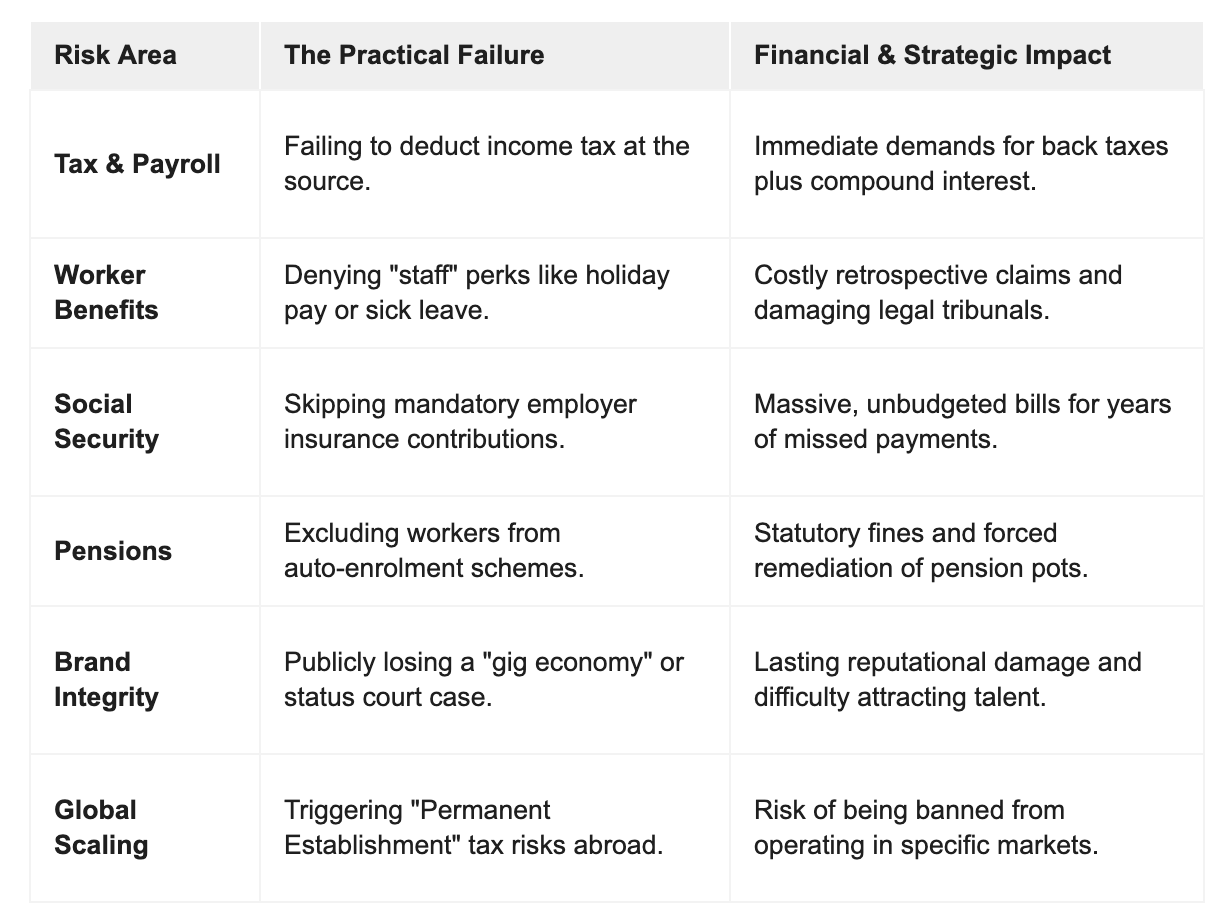
These risks explode the moment you hire across borders. A setup that passes the test in London might be a total compliance disaster in Paris or Berlin.
Often, it only takes one disgruntled "contractor" filing a claim for holiday pay to trigger a full-scale audit of your entire international workforce.
To stay safe, you must stop treating classification as a "set and forget" admin task; it is a live strategic risk.
By auditing how your team actually operates, rather than just trusting the contract, you protect your budget and ensure your global growth isn't derailed by an avoidable legal headache.
How Employers Assess Contractor Status Correctly
Taking ownership of contractor classification is a vital employer responsibility that requires looking past the paperwork to the daily grind. To maintain a clean compliance assessment, you must evaluate the actual reality of the working relationship.
This is not about abstract legal theory; it is about how much power you exercise over the person doing the work. If you treat a freelancer like a member of staff by setting their hours, managing their methods, and providing their equipment, regulators will likely view them as an employee, regardless of what your contract says.
Control and Direction
The most significant red flag in any audit is the level of control you exert. A genuine independent contractor is hired for a specific outcome, but they remain the master of the process.
If your managers are providing step-by-step instructions, enforcing specific working hours, or conducting formal performance reviews, you have crossed the line from "client" to "employer."
In a compliant setup, the contractor decides how to achieve the result. If you find yourself approving their lunch breaks or insisting they attend internal "all-hands" meetings that are not project-specific, you are assuming the role of an employer. To stay safe, focus on the deliverables and leave the methodology to the professional you have hired.
Economic Dependence
Regulators look closely at whether a worker is in business on their own account or if they are financially dependent on your company.
If a contractor works forty hours a week for you, year-round, and has no other clients, they are economically dependent. This makes them look like an employee in disguise.
Integration is the other side of this coin. Ask yourself: is this person "part and parcel" of your organisation? If they have a company email address, appear on your internal org chart, or manage your permanent staff, they are integrated into your business operations.
True contractors should operate on the periphery, providing specialist skills without becoming a permanent brick in your corporate structure.
Substitution and Autonomy
A hallmark of self-employment is the right of substitution. A real business entity should be able to send a qualified substitute to complete the work. If the contract insists that only one specific individual can do the job, it looks like a personal service agreement. This is a classic trait of employment that tax authorities watch for.
Autonomy also extends to the tools of the trade. An independent professional should generally provide their own equipment, software, and insurance. If you are providing a company laptop, paid software licences, and office space, you are essentially providing the tools of the trade. This shift in resources often shifts the legal relationship toward employment.
By focusing on these practical pillars of control, dependence, and autonomy, you can make informed, defensible decisions. Accurate contractor classification is not just about avoiding taxes; it is about ensuring that your business model reflects the legal reality of your workforce.
Applying Contractor Rules in Real Hiring Scenarios
Correct classification is achieved by evaluating the daily reality of a role rather than the original contractual intent. Even a robust legal agreement is rendered void if the actual working relationship shifts into one of employment over time.
This process requires a cold, objective look at how a worker interacts with your team. If the boundaries between a specialist provider and a core staff member become blurred, the legal protection of your contract vanishes.
To stay compliant, you must treat classification as a living process, ensuring that operational habits do not accidentally transform a safe contractor into a high-risk "de facto" employee.
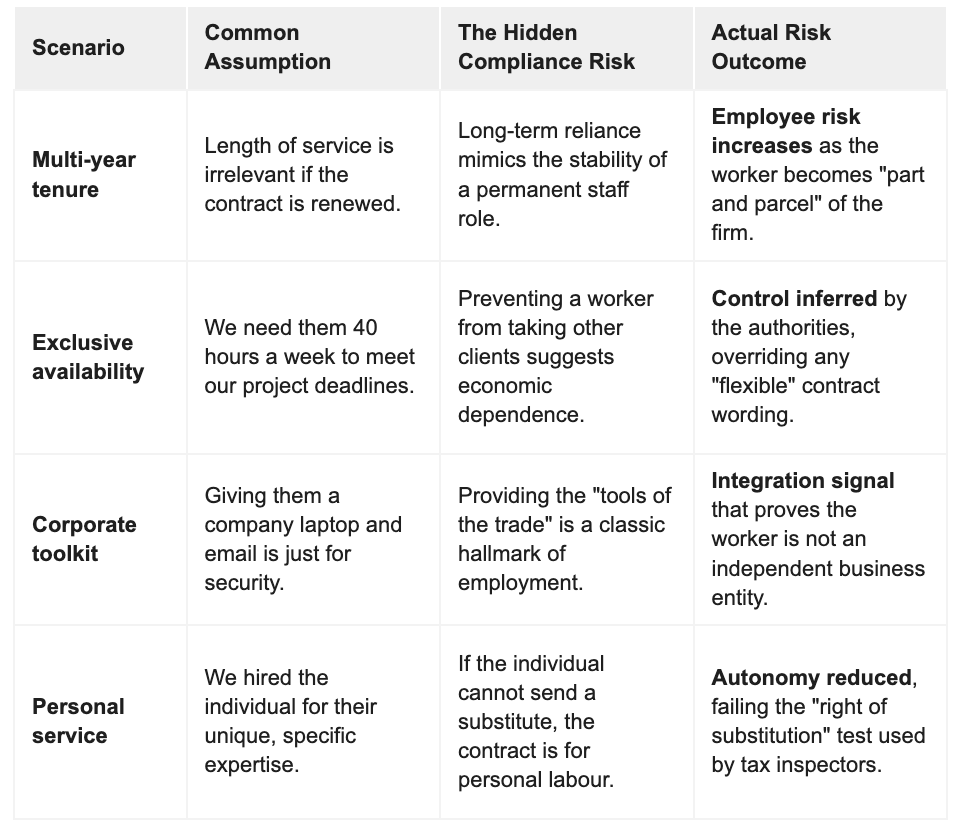
Most misclassification cases arise from operational drift rather than intentional evasion. A relationship often begins as a clean, project-based consultancy, but as a worker becomes more helpful, they start attending internal strategy meetings or managing permanent staff.
To fully resolve this risk, managers must treat the boundary between staff and contractors as a fixed line that cannot be crossed for convenience. If a role requires company equipment and daily supervision, it is an employment role. Regularly auditing these real-world scenarios ensures your global hiring strategy remains a competitive advantage rather than a legal liability.
Securing Your Workforce: Moving from Uncertainty to Compliance
Independent contractor misclassification is rarely deliberate, but it is increasingly expensive. As this guide has shown, regulators assess the reality of the working relationship rather than contractual labels. Control, integration, and economic dependence are the decisive factors, and without a structured assessment framework, organisations can drift into compliance risk as their global workforce scales.
I support HR and compliance leaders in translating contractor classification rules into practical, defensible decisions. By reviewing how contractor relationships operate in reality, I help organisations identify risk early and put safeguards in place before audits or claims arise, ensuring international growth remains compliant and sustainable. Want to ensure compliant contractor relationships? Get in touch with me today.




.jpg)